

An encouraging, human-voiced deep dive written specifically for coding freshers and self-taught developers. It breaks down the 80/20 problem, system architecture quirks, human UX empathy, and why writing code syntax is only a minor fraction of real software engineering.
If you spend any time on technology websites, YouTube, or social media lately, you have probably seen some very scary headlines:
If you are a student or a fresher who is currently spending hours learning HTML, CSS, JavaScript, or React, these headlines can make you feel very stressed. You might wonder: “Am I wasting my time? Will I even get a job when I graduate?”
Let’s take a deep breath and look at the real truth.
Yes, AI (like ChatGPT or Copilot) is changing the tech world very fast. It can write a block of code in two seconds, find a missing semicolon, and explain a confusing concept easily. But writing code is only a small part of being a real software developer.
AI is not going to destroy the developer job. Instead, it is changing what a developer does. Let’s break down exactly why real, human developers will always matter, and why you should keep learning.
To people who don't know how to code, programming looks like typing fast on a keyboard. They think that if a computer can type the code instantly, the human is no longer needed.
This is a big misunderstanding.
AI works by looking at billions of lines of code that humans already wrote in the past. It guesses what the next line of code should look like based on that history.
If you ask an AI: "Write a code for a shopping cart page," it can give you a beautiful, working page instantly. Why? Because thousands of people have already built shopping carts and put them on the internet. The AI just copies that pattern.
But AI does not know your specific website. It doesn’t know:
AI can write the code, but a human developer has to connect all the pieces safely and make sure it works perfectly in the real world.
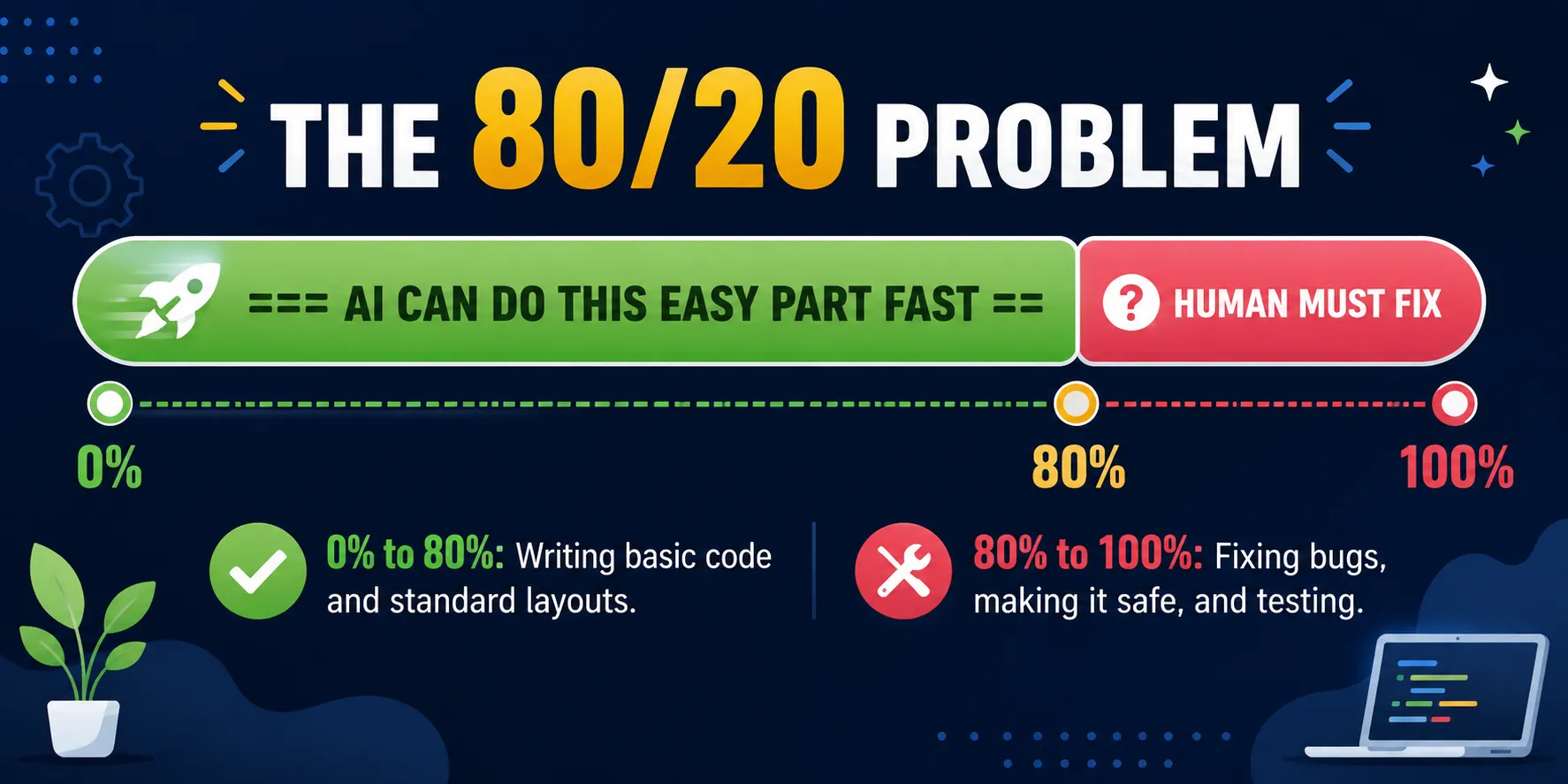
In the past, developers had to spend hours memorizing exact commands, setting up basic folders, and writing repetitive code (called boilerplate code).
Today, AI can do that boring, repetitive work for you. This is actually amazing news for freshers! It means you can build your projects much faster. But it also means your job is changing.
Instead of spending three hours writing a piece of code, you will ask AI to write it in three seconds. Then, your job for the next hour is to read that code carefully and check it.
You have to ask yourself:
To check the AI’s work, you still need to know the fundamentals of programming deeply. You cannot check someone else's homework if you don't know the subject yourself!
A website can have perfect code, but if it is confusing to use, people will leave immediately.
Human developers have something that AI will never have: empathy. Empathy means the ability to understand how another person feels.
When a great frontend developer builds a website, they think about the user:
AI only follows rigid rules. It does not know what "trust" or "frustration" feels like. Humans build things for humans.
Many freshers think a developer's life is just sitting alone in a dark room, drinking coffee, and typing. This is a myth. In the real world, building software is all about communication.
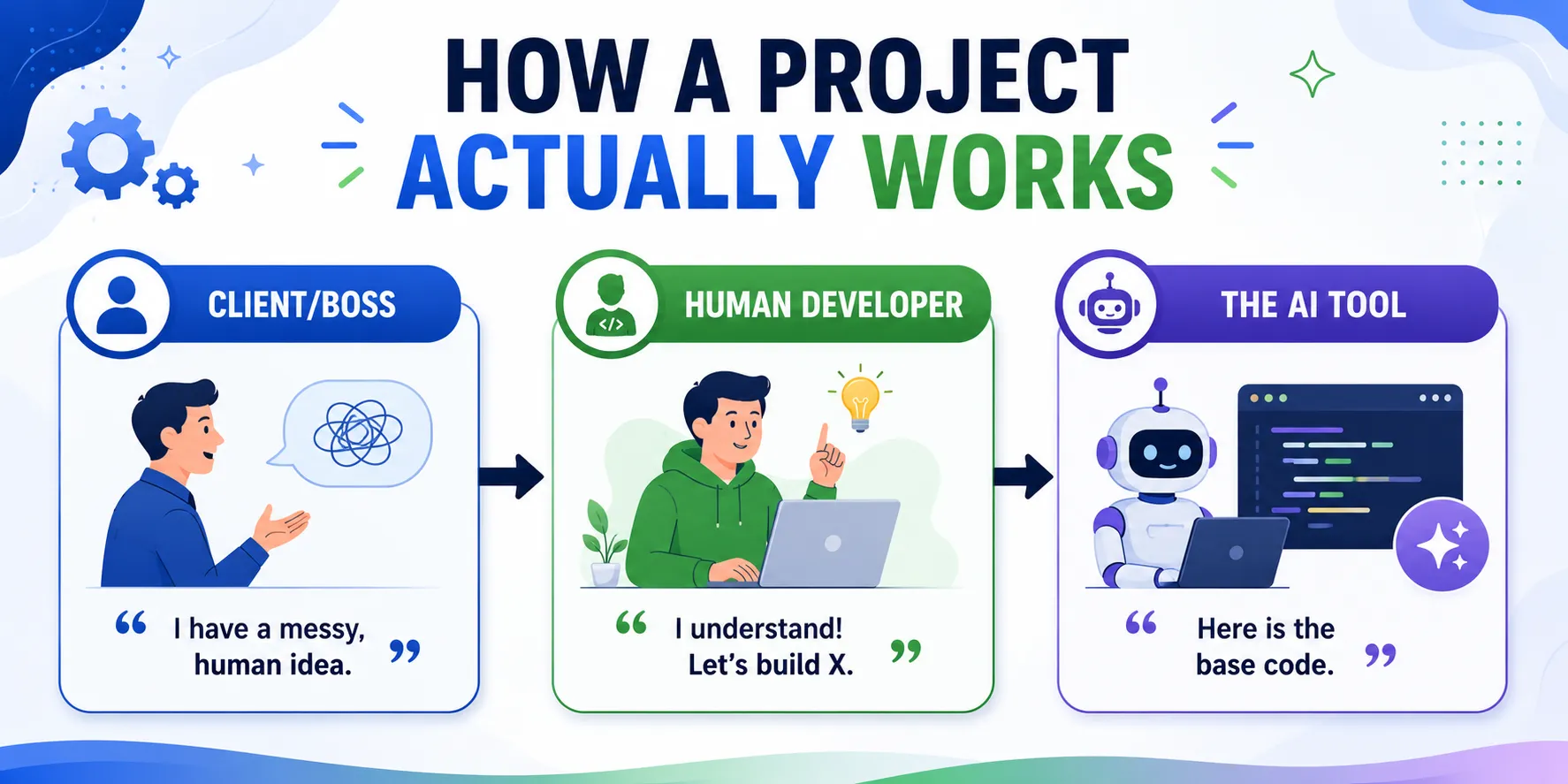
Clients and bosses usually do not know anything about coding. They don't say, "Please build a database with three tables and a REST API."
Instead, they say something messy like: "I want a website where people can sell old books, and it needs to look cool and be super safe."
An AI cannot sit down with a client, listen to their messy ideas, ask questions, and figure out what they actually need. A human developer has to act as the translator between human speech and computer logic.
Think of a software developer like a house builder. AI is like a super-fast machine that can lay down bricks in a straight line perfectly. That is very useful! But can that brick-laying machine design the entire house? No.
A great developer doesn't just look at one line of code; they look at the whole system (this is called System Architecture). They have to plan out:
AI can write a small block of code beautifully, but it completely struggles to see the big picture. It doesn't know how its code affects other files written months ago. Only a human mind can balance these big, complex decisions.
If you have written even a small program, you know that code can break in the weirdest ways possible. In the tech industry, we call these unusual problems "edge cases."
AI only knows what has happened before. When an entirely new problem pops up, AI gets confused. If you try to use AI to fix a brand-new type of bug, it will often give you the exact same wrong answer over and over again, completely trapped in a loop.
Human developers don't just guess answers; they use logic, intuition, and experience to solve mysteries. They think like detectives:
This deep, experimental problem-solving is something AI cannot do. It takes human grit and curiosity to hunt down the trickiest bugs in production.
Every day, thousands of malicious hackers are trying to steal user passwords, credit card numbers, and private data from websites. Making software secure is one of the most critical responsibilities of a developer.
Because AI copies patterns from the internet, it often copies bad habits too. If an open-source library has a security flaw, the AI will happily generate that flawed code for your project without realizing it is dangerous.
A human developer acts like a security guard. They understand how hackers think. They know how to write custom code to encrypt data, protect user privacy, and ensure that malicious actors cannot breach the system. Security requires continuous human vigilance, not automatic code generation.
If you are a beginner or a fresher learning to code today, you should not be afraid of AI. You should be excited! AI is like a free, personal teacher that sits next to you 24/7.
Here is how you can prepare for a successful career in this new era:
AI is a tool, just like the calculator was a tool for mathematicians. When the calculator was invented, math teachers didn't lose their jobs; they just stopped doing manual long division and started solving bigger, more important problems.
AI is your assistant, not your replacement. Keep learning, keep practicing, and focus on solving real problems for real people. The tech world still needs you, and it always will.

May 2026 | Blogs
Apr 2026 | Blogs
Apr 2026 | Blogs
Mar 2026 | Blogs
Mar 2026 | Blogs
Be the first one to share your thoughts 💭